
China Top 10 Textile Lamination Machine Manufacturers
China has become a significant production base for textile processing equipment, including advanced Textile Lamination Machine systems. These machines bond fabric layers with films, foams, membranes, or hot-melt adhesives. They support applications in protective clothing, automotive interiors, medical textiles, footwear, and outdoor products. A well-designed line can improve bonding consistency while reducing material waste and manual handling.
This guide introduces China’s top 10 textile lamination machine manufacturers through practical purchasing criteria. The review considers machine structure, heating control, coating accuracy, production speed, energy use, customization, and after-sales support. Factory experience also matters. A supplier may provide impressive specifications, yet real performance depends on installation quality, operator training, and suitable raw materials. Independent certifications, traceable testing records, export experience, and customer references can strengthen a manufacturer’s credibility.
No ranking is perfect. Some manufacturers disclose limited technical data, while others present broad capabilities without enough production evidence. Buyers should request sample trials, inspect key components, and confirm safety compliance for their destination market. Details such as roller temperature stability, web tension, adhesive compatibility, and emergency-stop design can strongly affect results. Small details matter. This article offers a practical starting point for comparing ten Chinese manufacturers, not a substitute for technical due diligence. Readers should verify current models, factory capacity, warranty terms, spare-parts availability, and service response before signing a contract. That extra work may seem slow, but it often prevents costly production interruptions later.
Textile Lamination Machines: Definition, Functions, and Industrial Applications
China Top 10 Textile Lamination Machine Manufacturers
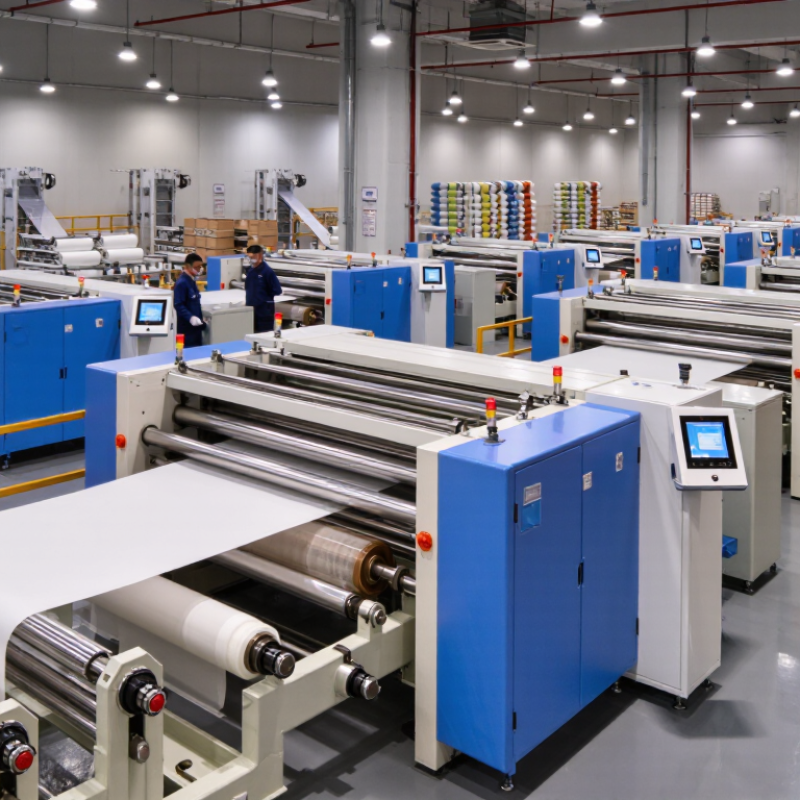
Textile lamination machines bond two or more layers into one functional fabric. They may use hot-melt adhesive, flame treatment, powder coating, or thermal bonding. The process improves waterproofing, insulation, wind resistance, and dimensional stability. The result is practical.
Modern lines usually include unwinding units, tension control, coating heads, heating zones, cooling rollers, and rewinding systems. Operators monitor fabric speed, coating weight, temperature, pressure, and peel strength. Small deviations can create wrinkles, weak edges, or uneven adhesion. Reality is less tidy.
Textile Exchange’s Materials Market Report 2024 reported global fiber production at about 124 million tonnes in 2023. It projects production could reach nearly 160 million tonnes by 2030. This expanding material flow supports demand for efficient finishing and composite textile equipment. However, higher output does not automatically mean better production. Energy use, adhesive waste, maintenance access, and worker safety still require careful evaluation.
In comparing China’s top ten manufacturers, buyers should examine machine width, production speed, compatible substrates, curing accuracy, and after-sales engineering. Industrial applications include protective clothing, medical textiles, automotive interiors, roofing membranes, furniture fabrics, and outdoor equipment. A machine designed for breathable apparel may perform poorly with heavy technical fabrics. Plant trials remain essential, although many purchasing decisions still rely too heavily on brochures.
China Top 10 Textile Lamination Machine Manufacturers - Textile Lamination Machines: Definition, Functions, and Industrial Applications
| No. | Machine Configuration | Definition and Main Function | Common Lamination Method | Typical Textile Materials | Typical Industrial Applications | Typical Working Width | Key Process Variable |
|---|---|---|---|---|---|---|---|
| 1 | Hot-Melt Film Lamination Machine | Bonds a thermoplastic adhesive film between textile layers using controlled heat and pressure. | Thermoplastic hot-melt film | Polyester, nylon, cotton, polyurethane films, nonwovens | Protective clothing, outdoor apparel, footwear components, technical fabrics | 1.6–3.2 m | Temperature, pressure, dwell time |
| 2 | Flame Lamination Machine | Uses a controlled flame to melt the surface of polyurethane foam before pressing it onto fabric. | Flame-activated foam bonding | Polyurethane foam, polyester, knitted fabrics, woven fabrics | Automotive interiors, upholstery, mattresses, sportswear | 1.6–2.5 m | Flame intensity and line speed |
| 3 | Hot-Roll Lamination Machine | Combines textile layers through heated rollers that activate adhesive or thermoplastic coating. | Heated calender or nip-roll bonding | Polyester, cotton, viscose, nonwoven substrates | Interlinings, curtains, labels, home textiles, garment components | 1.6–3.4 m | Roll temperature and nip pressure |
| 4 | Powder-Dot Lamination Machine | Applies thermoplastic adhesive powder in controlled dots, followed by heating and pressure bonding. | Scattered adhesive powder | Woven fabrics, knitted fabrics, fleece, polyester and polyamide textiles | Fusible interlinings, tailoring materials, garment reinforcement | 1.6–2.8 m | Powder density and activation temperature |
| 5 | Adhesive-Coating Lamination Machine | Coats one substrate with liquid adhesive and combines it with a second textile layer. | PU, acrylic, EVA, or other liquid adhesive coating | Polyester, nylon, cotton, membrane fabrics, nonwovens | Waterproof clothing, medical textiles, filtration media, soft goods | 1.6–3.2 m | Coating weight and drying profile |
| 6 | Membrane Lamination Machine | Joins a textile face fabric to a breathable, waterproof, or windproof membrane. | Hot-melt, reactive adhesive, or transfer-film bonding | Polyester, nylon, PTFE, TPU, PU membranes | Rainwear, sportswear, military clothing, tents and technical covers | 1.5–2.5 m | Bond uniformity and membrane protection |
| 7 | Foam-to-Textile Lamination Machine | Creates a composite by bonding foam to fabric for cushioning, insulation, or surface support. | Flame, adhesive, or hot-melt bonding | PU foam, polyester foam, knitted fabrics, woven fabrics | Automotive seats, furniture, bedding, protective pads | 1.6–2.5 m | Foam compression and bonding strength |
| 8 | Nonwoven Lamination Machine | Laminates nonwoven webs with films, fabrics, foams, or additional nonwoven layers. | Hot-melt, thermal, ultrasonic, or adhesive bonding | PP, PET, viscose, spunbond and meltblown nonwovens | Hygiene products, medical gowns, filtration and construction textiles | 1.6–4.0 m | Web tension and layer alignment |
| 9 | Ultrasonic Textile Lamination Machine | Uses high-frequency mechanical vibrations to join compatible thermoplastic textile layers. | Ultrasonic welding or spot bonding | Polyester, polypropylene, nylon, thermoplastic nonwovens | Medical products, filters, technical bags, automotive components | 0.3–2.0 m | Frequency, amplitude, and weld pressure |
| 10 | Continuous Multi-Layer Lamination Line | Integrates unwinding, adhesive or film application, heating, pressing, cooling, and rewinding for continuous production. | Multi-layer hot-melt or coated-adhesive lamination | Textiles, films, foams, membranes, paper and nonwovens | Industrial fabrics, packaging textiles, roofing membranes, composites | 1.6–4.0 m | Line speed, tension, temperature, pressure |